
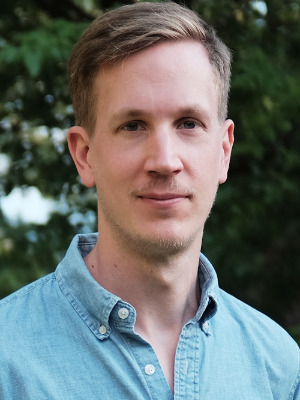
Prof. Dr. Alexandre Bovet
Alexandre is the founder and head of the Quantitative Network Science group. His team develops machine learning methods and mathematical models to provide quantitative answers to social, biological, and economic questions.
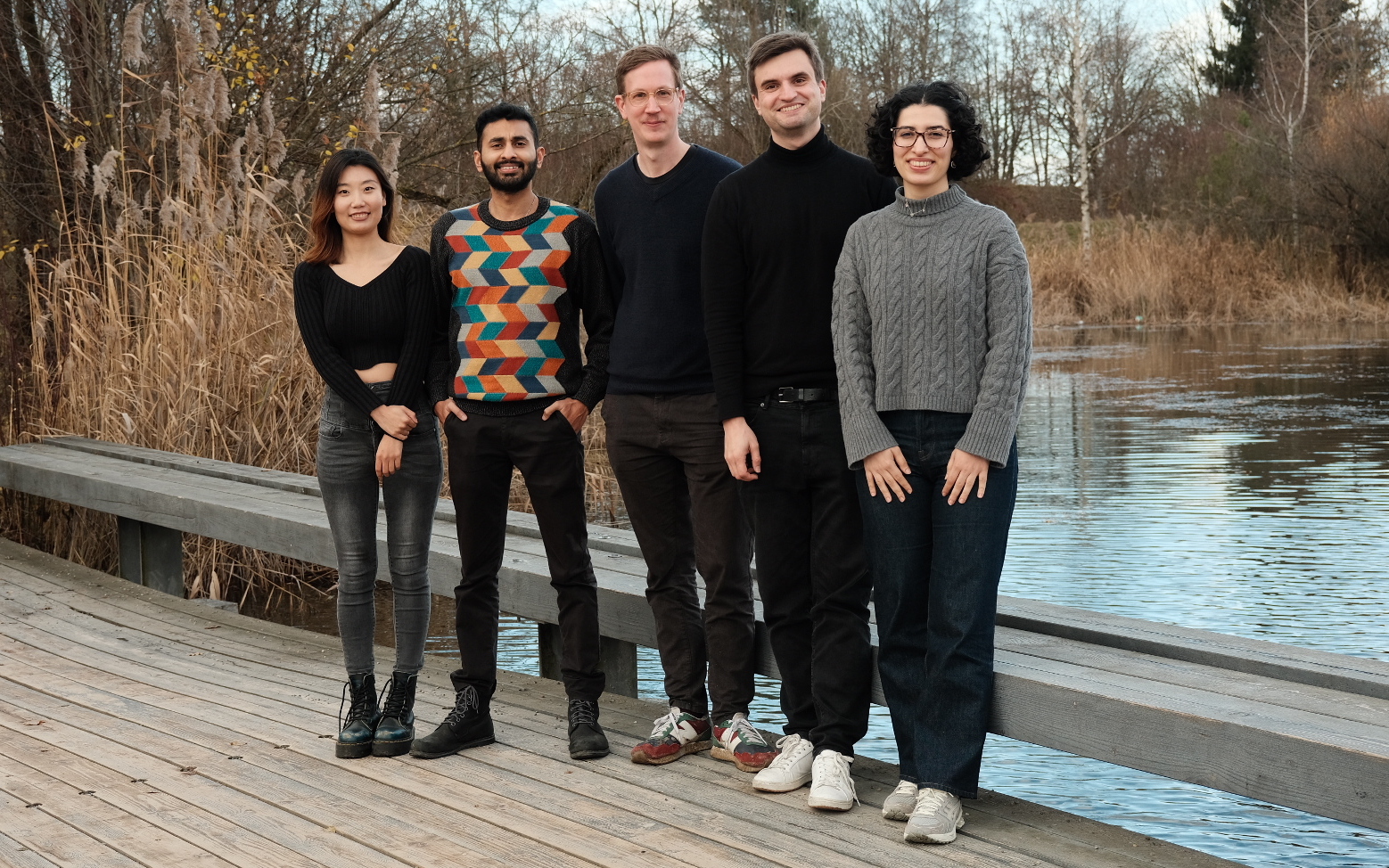
Alexandre is the founder and head of the Quantitative Network Science group. His team develops machine learning methods and mathematical models to provide quantitative answers to social, biological, and economic questions.

Juni Schindler is a postdoctoral researcher in the Quantitative Network Science group at DM³L since November 2025. They contribute to the DIZH-funded project “New Digital Tools for Media Monitoring and Discourse Analysis”, which develops a machine learning framework grounded in communication theory to map how different journalistic perspectives interconnect in media reporting. More broadly, Juni draws on network science, machine learning, and topological data analysis to design methods for the multiscale analysis of complex networks, with applications in computational social science. Juni completed their PhD research under the supervision of Prof. Mauricio Barahona in the Department of Mathematics at Imperial College London, focusing on topological and graph-diffusion-based techniques for multiscale clustering. Prior to the PhD, they earned an MSc in Applied Mathematics from Imperial College and an MA in Digital Media from Goldsmiths, University of London.

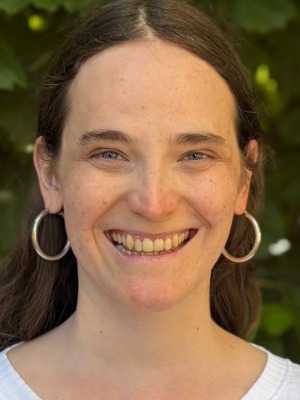
Wanda is a PhD Candidate in the Quantitative Network Science Group (DM3L) at the University of Zurich. She is part of a collaboration with the “Evolution and Genetics of Social Behaviour” group of Prof. Anna Lindholm at UZH and the Lab of Prof. Andrés Bendesky at the Zuckerman Mind Brain Behaviour Institute of Columbia University, to address unresolved questions on causes and consequences of inbreeding depression. Her work is centred around a long-term study of the social, genetic and mating networks of free-living wild house mice. By combining approaches from multi-layer and temporal networks, she works to adapt and develop methods to characterize the social structures of house mice and how they relate to mating, potentially answering if house mice avoid inbreeding. She holds a MSc in Physics from the University of Zurich and a BA in PPE from the University of Lucerne. Previously, she studied tree graphs as platforms for hyperbolic lattices.

Yasaman Asgari is a PhD student in Data Science at the Department of Mathematical Modeling and Machine Learning (DM3L) and Digital Society Initiative (DSI) at the University of Zurich since September 2023. Before her doctoral studies, Yasaman earned her Master’s degree in Computer Science from École Normale Supérieure de Lyon, France, where she explored building evaluation settings for testing dynamic community detection in fine-grained temporal networks. Her research interests include complex systems, temporal networks, and dynamic community detection with applications to real-world problems.