
Bachelor of Sciences in Applied Mathematics and Machine Learning
A Bachelor's degree program in Applied Mathematics and Machine Learning is advantageous as it offers students a structured and comprehensive education in these areas. The Bachelor's program establishes a solid mathematical foundation, which is then built upon with modules in computing and data analysis. The program equips students with the necessary skills, tools, and knowledge to excel in a data-driven industry. It prepares them to solve real-world problems and contribute to innovation and growth. The Applied Mathematics and Machine Learning program not only meets the current needs of the industry but also anticipates future trends, making graduates highly sought after in the job market.
Target students
A Bachelor's degree program in Applied Mathematics and Machine Learning is tailored for individuals who are interested in mathematics, statistics, and computer science and want to work in data-driven fields in various industries. It is ideal for those who want to develop expertise in data analytics, AI, and predictive modeling and enter the growing regional, national, and international job market for data experts.
Learning objectives
- Solid basic knowledge of maths, programming, and data analysis
- Reformulate practical problems into mathematical models and analyze them
- Correctly analyze collected data using statistical methods and critically reflect on results
- Recognising structures in data and generating new hypotheses with machine learning
- Question scientific work and competently communicate research results in writing and orally.
Program structure

Overview of the modules

Typical week in the first two semesters
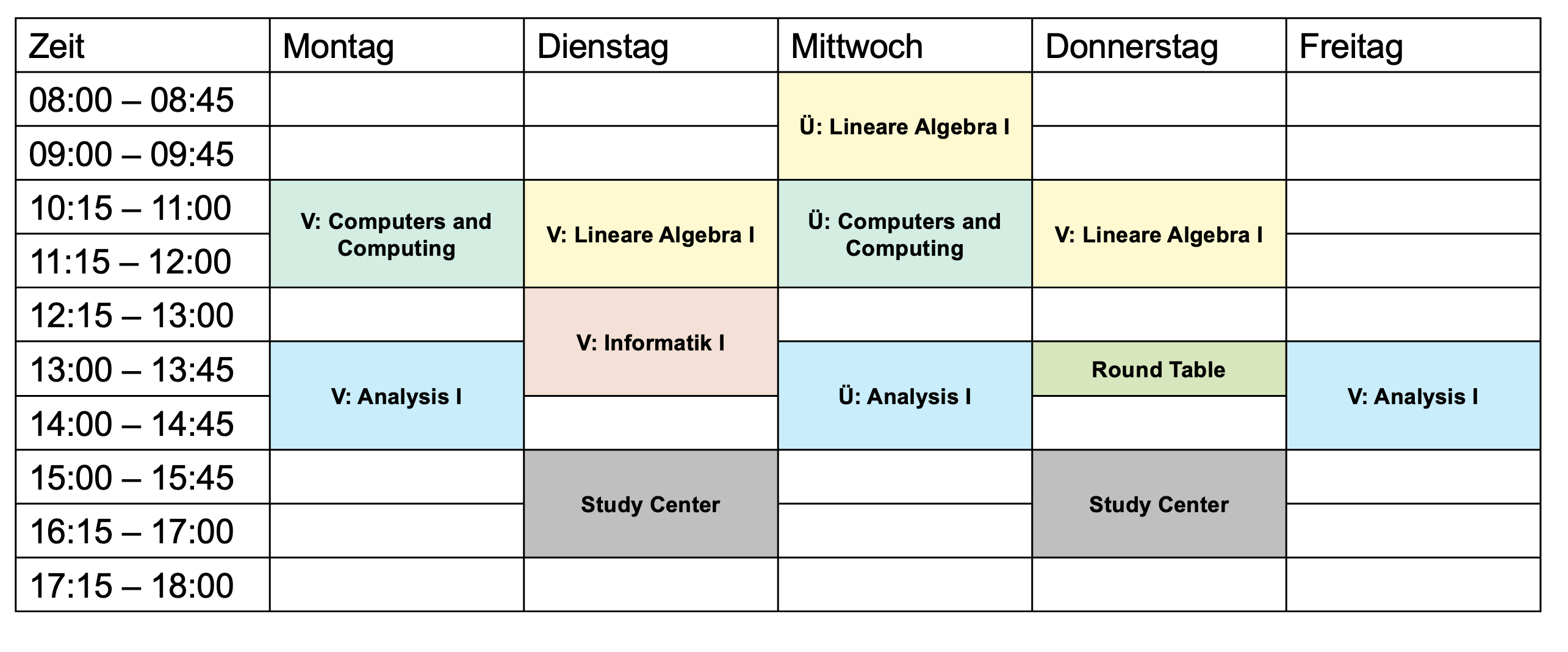
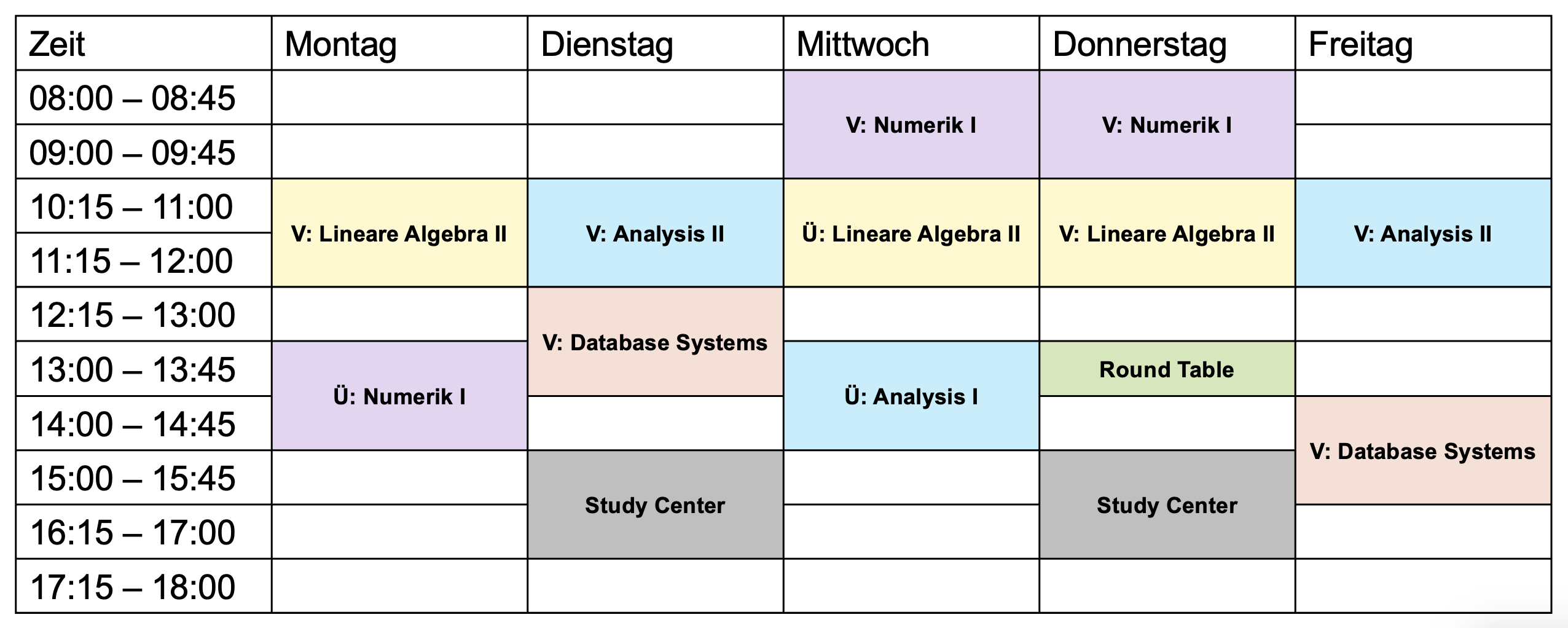
(depending on room allocation, exercise sessions may slightly move)
Possible electives
This list is not exclusive. See also here
- M3L321 Complex Networks Theory and Applications
- STA121 Statistical Modeling
- MAT001 Cryptography
- MAT005 Coding Theory
- MAT503 Introduction to Algebraic Topology
- MAT556 Category Theory
- MAT602 Functional Analysis
- MAT632 Theoretical Physics for Mathematicians I
- PHY525 Quantum Physics for Non-Physicists